News
Contact UsMagnetic Card Holder Manufacturer for Bulk Orders
-
 author
- 8 October 2026
Choosing a magnetic card holder manufacturer for bulk orders starts with the card program, not the lowest quoted unit price. A suitable supplier must be able to match the holder to the card thickness and use case, provide samples that can be evaluated consistently, explain the pack configuration, and keep the approved reference under production control.
This guide is for distributors, importers, retailers, and private-label brands comparing suppliers for recurring trading-card programs.
Qualify the complete route: product fit, closure and visibility, sample evidence, packaging, quotation assumptions, and change control. A holder can look attractive in a photograph yet be unsuitable if the card moves, the closure is difficult, the pack wastes space, or later production no longer matches the approved sample. The checks below turn supplier search into a comparable RFQ and approval process.
Define the buying task before comparing suppliers
A magnetic card holder can serve several channels: protection for higher-value singles, retail display, collector storage, or a private-label accessory line. Those uses do not require the same presentation, pack count, or handling experience.
Write the intended channel, card types, selling unit, estimated order pattern, and destination market before asking a magnetic card holder supplier to recommend a model.
- Name the card format and maximum thickness, including any sleeve or inner protection used in the program.
- State whether the holder will be shipped as a single unit, multipack, or component of a larger retail set.
- Describe the handling task: shelf display, online fulfillment, repeated opening, storage, or resale presentation.
- List visibility, closure, surface, labeling, and packing requirements that can be checked on a sample.
Match the holder to the actual card and handling conditions
Measure the object that will enter the holder rather than relying on the nominal card name. Record card width, height, and thickness, then repeat the measurement with the exact sleeve or insert used for sale.
A magnetic holder that fits a bare card may be too tight with a sleeve, while a cavity with excessive clearance can allow movement during picking, shipping, or display.
Evaluate the complete construction, not a material label in isolation. Review how the two halves align, how the closure engages, whether edges remain visible, and whether the holder can be opened without damaging the pack or card.
If the program needs a specific thickness family, request the relevant model and test it with a reference set instead of assuming that one size covers every SKU.
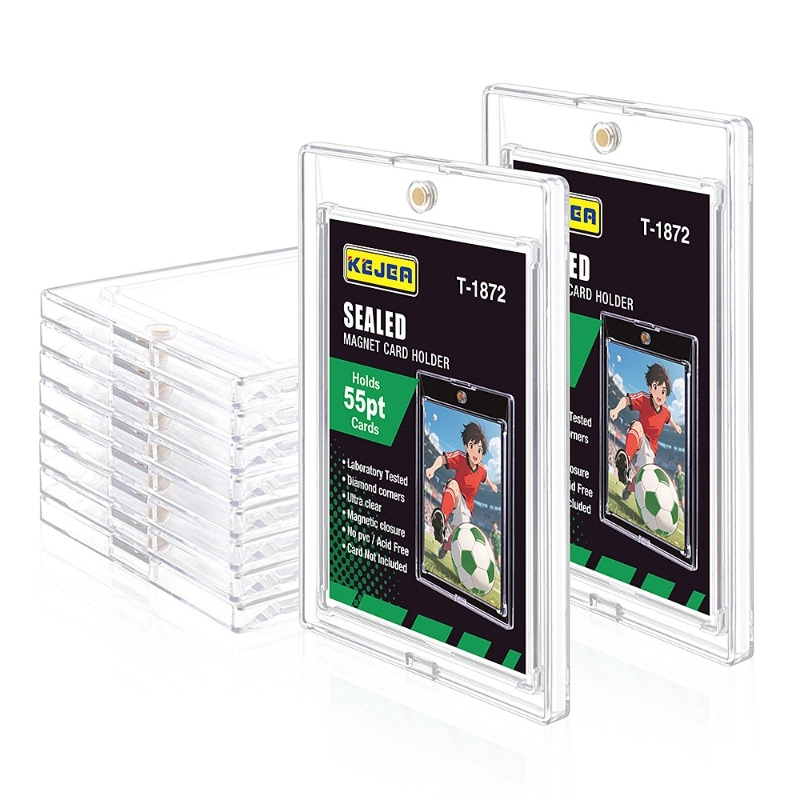
Use a repeatable acceptance routine for every candidate. Insert the reference card, close the holder around the full perimeter, open it using the intended customer action, and repeat the cycle several times.
Record edge contact, corner pressure, shifting, visible distortion, particles, scratches, and any tab or magnet that does not engage. These are observable conditions; they are more useful than an unqualified statement that one holder is stronger or clearer.
Qualify samples before discussing final price
Ask each candidate supplier for samples identified by model or sample code. Use the same card set, sleeve condition, lighting, opening method, and recording sheet for every sample. The approval record should capture the tested dimensions, closure result, appearance, pack method, and date.
If a sample fails, describe the location and condition—for example, a corner lifts when the sleeved reference is inserted—so the correction can be reviewed later.
Sample review should include the commercial pack, not only an unboxed holder. Check whether units rub against one another, whether protective film or bags are needed, and whether labels remain readable after packing.
For online retail, inspect how the packed unit survives normal pick-and-pack handling. For a distributor, check whether inner quantities divide cleanly across customer orders. The right acceptance test follows the channel rather than a generic factory checklist.
KEJEA presents a dedicated magnetic card holder range that includes different holder constructions and thickness options for trading-card programs. The range is positioned for distributors, wholesalers, brands, and bulk buyers, while the site also identifies OEM/ODM support and sample evaluation.
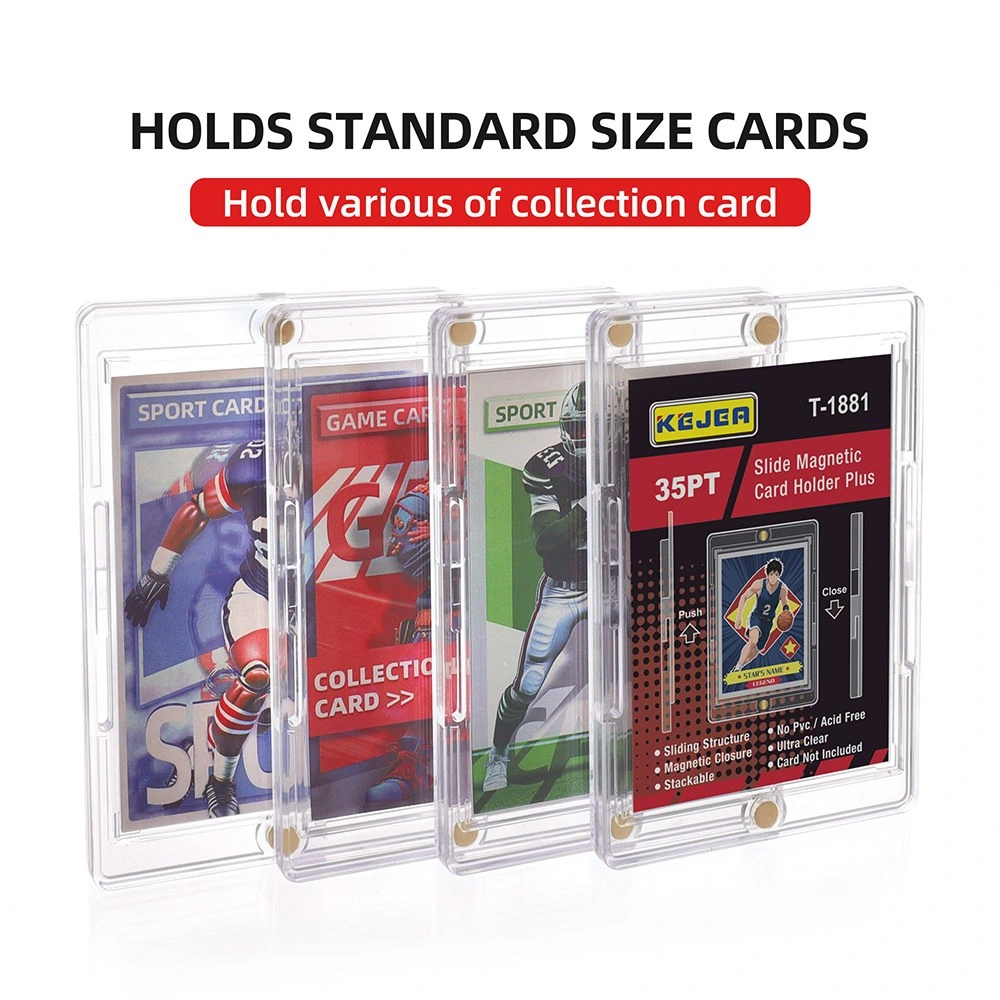
That combination gives a buyer two practical routes: start with an existing model for faster comparison, or define a custom requirement when the card, closure, color, or presentation needs are outside the chosen standard. The decision still depends on sample approval against the buyer’s own reference cards.
For a sourcing team, the useful value is not a long list of magnetic models. It is the ability to connect a selected model to a documented sample, a packaging version, and a repeat-order reference.
KEJEA’s service structure includes a product design and sampling service as well as a mass production and quality control process, so an inquiry can be organized around the physical approval first and the production handoff second. Buyers should confirm the exact scope, commercial terms, and project assumptions for their own program.
Compare packaging and quotations on the same basis
Wholesale cost is affected by more than the holder itself. Before comparing offers, standardize the selling unit, bag or insert, inner-box quantity, master-carton quantity, carton dimensions, gross weight, labels, and any retail packaging. A lower piece price can represent a different pack count, a larger order assumption, or a carton that consumes more freight and warehouse space.
Ask every magnetic card holder manufacturer to identify what is included and excluded. Separate recurring unit cost from one-time artwork, tooling, or development charges. Record the currency, trade term, quotation validity, destination assumptions, and whether the offer covers a stock structure or a requested change. You do not need a perfect landed-cost model at the first contact, but you do need identical assumptions across competing quotations.
Packaging should follow physical approval. If the holder dimensions, orientation, surface protection, or quantity changes, the bag, insert, box, label position, and carton plan may also change.
For private-label work, approve the product and pack structure before releasing final artwork. Include barcode data, authorized logo files, market language, and any required importer or warning information in a separate revision-controlled approval.
Protect repeat orders with production and change control
A qualified supplier should be able to identify the approved reference used for production. Keep the sample code, drawing or specification revision, packaging version, and approval date together.
For repeat orders, ask for advance notice of changes to material, tooling, dimensions, closure, appearance, or packing. Recheck the critical fit and closure points whenever a card format or retail pack changes.
Use incoming checks that a warehouse or quality team can repeat. Compare selected units with the approved sample, confirm the pack count and label version, and record any visible or functional deviation.
This does not require the buyer to invent a laboratory test. It requires a clear acceptance description and a shared reference so that a dispute is based on an observable difference rather than a vague quality judgment.
If a supplier proposes a change, evaluate its effect on the buyer’s channel before accepting it. A different closure may change opening time; a different surface may change display appearance; a different pack orientation may change carton utilization. Treat the approved sample as a controlled commercial reference, not as a one-time photo used only during the first quotation.
Prepare an RFQ a magnetic card holder manufacturer can answer
A useful RFQ gives the supplier enough information to quote the same project the buyer is evaluating. Attach reference-card dimensions or physical samples where possible, state the intended sleeve condition, name the preferred holder structure, and describe the sales channel. Include the estimated quantity, unit-pack concept, inner and master packaging, branding scope, destination market, and requested quotation basis.
- Reference card or dimensioned drawing, including maximum thickness and sleeve condition
- Required holder style, visibility, closure, color, and any display or stacking requirement
- Sample quantity and acceptance checks for fit, opening, closure, appearance, and pack condition
- Selling unit, inner quantity, carton quantity, label or barcode needs, and packaging revision
- Commercial assumptions: currency, trade term, quantity basis, one-time charges, and open questions
When the product and pack requirements are ready, use the verified magnetic card holder range as a starting point and connect the inquiry to the sampling and quality-control discussion. A focused request reduces back-and-forth and helps the buyer compare a standard wholesale proposal with a custom option on equal terms.
Conclusion
The right magnetic card holder manufacturer is the one that can connect product fit, sample evidence, packaging, quotation assumptions, and repeat-order control. Start with the card and channel, approve the complete holder with a repeatable checklist, normalize the commercial basis, and preserve the approved reference through production. That sequence gives importers, distributors, retailers, and private-label brands a defensible route from supplier search to a usable bulk program.
Request a magnetic card holder quote
Ready to compare magnetic card holders for wholesale or custom supply? Send a magnetic holder inquiry with the card dimensions, sleeve condition, target quantity, packaging plan, branding scope, and destination market. KEJEA can then review the request against the relevant product and service path.
FAQs
How do I choose a magnetic card holder supplier for bulk orders?
Start with the actual card and sleeve, then compare closure, visibility, sample performance, packaging, and quotation assumptions. Require a dated approval reference and ask the supplier to identify exclusions or proposed changes. A supplier is easier to qualify when the same physical and commercial criteria can be applied to every candidate.
Is a magnetic card holder suitable for every trading card?
No. Suitability depends on the card’s external dimensions, thickness, sleeve condition, and the holder cavity. Approve the exact reference card or a representative range. Do not treat a nominal card category or a product photograph as proof of universal fit.
What should be included in a magnetic card holder RFQ?
Include card measurements, sleeve condition, preferred structure, intended use, quantity, unit and carton packing, branding requirements, destination market, and quotation assumptions. Add the acceptance checks you will use for fit, closure, appearance, and pack condition so the supplier can respond to a defined project.
When should private-label packaging be approved?
Approve the physical holder and pack structure first. Changes to dimensions, orientation, surface separation, or pack count can affect bags, inserts, boxes, labels, and cartons. Release final artwork only after those physical decisions have a controlled revision and approval date.

Molecular
Versatile Industrial Feedstocks
Call Us
0769-88389789
High-performance
Guangdong KEPU Technology Co., Ltd.
Guangdong KEPU Technology Co., Ltd. is a source manufacturer specializing in trading card protection solutions, integrating R&D, tooling, production, and quality control in-house. With scalable manufacturing capacity, a mature quality control system, and OEM/ODM capabilities, we provide professional-grade, reliable product support for the global trading card collection and resale market.
- We’re professional
- We use quality material
- 100% customers satisfaction