News
Contact Us2026 Trading Card Display Trends How to Build a Retail-Ready Wholesale Accessory Line
-
 author
- 3 September 2026
Trading card display is taking a bigger role in the accessory business in 2026. Cards move through hobby stores, e-commerce listings, live breaks, and social channels, so customers often see the presentation before they handle the product. Trading cards also remain a major commercial category. At Asmodee, TCGs accounted for 61% of full-year revenue, with first-quarter TCG sales up 23.1%.
For distributors and private-label brands, this changes the buying decision. A display product has to fit the intended card or slab, present well, survive handling and shipping, and sit at the right retail price. The best assortment is not the one with the most SKUs. It is the one that fits the sales channel and can be reordered consistently.

Why Retail and Live Selling Are Changing Trading Card Display Demand
Display quality now reaches customers through more than a store shelf. Live breaking, livestream commerce, marketplace photography, and short-form video expose surface clarity, fit, and presentation in close-up.
That channel shift is already visible across the collectibles business. In 2026, 52% of industry professionals reported that up to half of their products were designed specifically for live breaks, livestreams, or social media.
For accessory buyers, the practical impact is simple: products need to look good where they are actually sold.
Match the Product to the Display Use Case
A card stand, magnetic holder, and graded-card protector solve different problems.
A simple stand works as an add-on for retail display, card shows, or livestream desks. Magnetic holders belong naturally in a more premium protection tier. Graded-card products serve slab owners who care about both protection and presentation.
That product ladder also keeps inventory easier to explain. A retailer can offer a basic display option, a premium raw-card solution, and a graded-card option without filling the shelf with near-duplicate SKUs.
For distributors already carrying sleeves and toploaders, display products can extend an existing protection range rather than create a separate category from scratch. KEJEA’s Trading Card Supplies Wholesale Guide 2026 covers how those core protection products fit into a broader wholesale assortment.
Retail and Live Selling Call for Different Details
A sports card stand on a breaker’s desk has a different job from one inside a glass showcase.
Live sellers tend to care about camera angle, stability, footprint, and how clearly the card stays visible. Retailers also have to think about shelf space, packaging condition, scratches from handling, and whether staff can quickly explain what the product fits.
That is why the intended sales channel belongs in the RFQ. It gives the supplier a clearer basis for recommending a product instead of treating every display order as the same project.
Building a Display Assortment Without Overloading Inventory
For trading card accessories wholesale, assortment planning is as important as individual product selection. Too many colors, PT sizes, structures, or display formats can turn into slow stock.
A better starting point is a compact range built around products with clearly different jobs.
Card Stands Work Best as an Add-On Category
Card stands are useful because they can add a display function without changing the protection product itself.
KEJEA’s clear sliding card display stand is one example from its current stand range. Instead of treating a stand as a standalone hero product, distributors can pair this category with magnetic holders or graded-card products already in the assortment.
Compatibility matters more than a long specification sheet. Test the real holder or slab on the stand. Check the viewing angle and stability. A compact stand is useful only when it stays balanced with the products customers actually own.
Magnetic Holders Carry More of the Premium Display Role
Magnetic holders are a stronger fit when the customer expects rigid protection and a cleaner presentation.
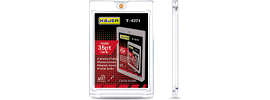
KEJEA’s current magnetic holder range covers multiple structures and thickness options. For example, its 35pt magnetic card holder is designed around a 63 × 88 mm card format and is available for OEM/ODM projects.

The important point for a wholesale buyer is not the number of PT options available. It is whether the chosen sizes match real sales demand.
Card thickness, dimensions, sleeve use, cavity fit, and closure behavior all affect the final result. Carrying more sizes without enough demand only creates extra inventory.
Graded-Card Products Need a Fit-First Approach
Graded-card accessories deserve their own buying logic because slab dimensions can vary.
A generic “fits graded cards” description is not enough for a bulk order. Exact slab dimensions—or preferably a physical sample—give the factory something concrete to work from.
That small step matters. A product can look perfectly good in a catalog and still become a return problem if customers cannot use it with the slabs they own.
What B2B Buyers Need to Check Before Ordering
Once the product mix is clear, the conversation usually moves to price. That is where good sourcing decisions can become too narrow.
A lower factory quote does not always produce a lower landed cost. Fit problems, scratched clear surfaces, oversized cartons, repacking, and inconsistent repeat orders can quickly erase a small unit-price saving.
Test for Repeatability, Not One Perfect Sample
One clean sample proves that one piece can be made well. It does not prove production consistency.
Compare several pieces side by side. Check:
- Fit with the actual card, holder, or slab
- Surface clarity under direct light
- Scratches, rub marks, and edge finish
- Stand stability
- Magnetic alignment where relevant
- Packing condition after handling
Then pack a few samples the way they will actually ship and open them again. Clear plastic makes rubbing and handling marks easy to spot.
This kind of simple test gives far more useful information than judging a single presentation sample.
Look at Landed Cost and Reorder Risk
Packing density and carton setup deserve a place in quotation comparisons. Freight, protective packing, sorting labor, and damaged stock all affect the real cost of a sellable unit.
Repeat orders add another question: will the second and third production runs match the approved sample?
Keep the approved dimensions, appearance standard, packaging, branding, and carton setup as a production reference. That makes later quality discussions much clearer than writing “same as previous order” on a PO.
Why Manufacturing Capability Matters for Private-Label Programs
The supplier decision becomes more important once a project moves beyond a standard product.
A brand may start with an existing magnetic holder, then ask for different branding, retail packaging, a revised structure, or related display SKUs. Each additional handoff creates another place for specifications to drift.
KEJEA integrates product development, mold design, injection molding, assembly, and quality control within its manufacturing operation. Its current range spans magnetic holders, toploaders, graded-card products, semi-rigid holders, sleeves, Mini Snap products, and card stands.
That broader capability is more useful to a B2B customer than simply having a long catalog. A distributor can begin with a few proven categories, then expand the same product line without rebuilding the sourcing process for every new SKU.
OEM/ODM Is More Useful When the Process Is Clear
Customization alone is not much of a differentiator. The real value is having a workable path from idea to repeat production.
KEJEA’s OEM/ODM service process moves through requirement confirmation, design, physical samples, contract confirmation, mass production, packaging, shipment, and after-sales service. Sample approval covers practical details such as size, material, printing, and hand feel before production moves forward.
For private-label buyers, that creates room to start conservatively. An existing product can be tested first. Branding and packaging can follow. More colors, thicknesses, or related categories can be added once sales data supports the expansion.
That is usually a healthier route than launching a large custom range before the market has proved itself.
Conclusion
A strong trading card display line starts with the customer and sales channel, then works backward into product choice. Fit, presentation, packing, landed cost, repeatability, and inventory depth all matter more than simply carrying the largest catalog.
KEJEA’s strength for B2B buyers lies in combining a broad trading card protection range with product development, tooling, production, quality control, and OEM/ODM support. Distributors and private-label brands can start with existing products, validate the market, and expand the assortment as demand becomes clearer.
For a new trading card accessories wholesale project, send KEJEA your target card or slab format, estimated quantity, sales channel, branding needs, and packaging plan through the KEJEA inquiry page to discuss suitable products, samples, and a bulk quotation.
FAQ
Q1: What products belong in a basic trading card display assortment?
A: A practical starting range can combine card stands for general display, magnetic holders for premium raw cards, and graded-card protection for slab customers. The final mix depends on the retailer’s customer base and price points.
Q2: Do card stands work with magnetic holders and graded slabs?
A: Compatibility varies by holder width, thickness, weight, and stand geometry. Testing the actual combination before placing a bulk order is the safest approach.
Q3: What matters most when buying magnetic card holders wholesale?
A: Card dimensions, thickness, cavity fit, closure consistency, surface clarity, packing, and repeat-order quality matter more than carrying every available PT size.
Q4: Can KEJEA support private-label trading card accessories?
A: Yes. KEJEA provides OEM/ODM support covering product development, sampling, branding, packaging, production, and related customization. Specific options depend on the product and project.
Q5: What information helps KEJEA prepare a useful B2B quotation?
A: Card or slab format, target product category, estimated quantity, sales channel, branding requirements, and packaging preferences give the project team a much clearer starting point.

Molecular
Versatile Industrial Feedstocks
Call Us
0769-88389789
High-performance
Guangdong KEPU Technology Co., Ltd.
Guangdong KEPU Technology Co., Ltd. is a source manufacturer specializing in trading card protection solutions, integrating R&D, tooling, production, and quality control in-house. With scalable manufacturing capacity, a mature quality control system, and OEM/ODM capabilities, we provide professional-grade, reliable product support for the global trading card collection and resale market.
- We’re professional
- We use quality material
- 100% customers satisfaction