
Notizia
ContattaciCustom Trading Card Accessories OEM/ODM: A Buyer’s Guide from Concept to Production
-
 autore
- 15 Ottobre 2026
A trading card accessories OEM manufacturer should be evaluated on the full path from product brief to approved production, not on a promise of customization alone.
For a private-label brand, importer, distributor, or retail buying team, the key questions are whether the supplier can translate the use case into a workable specification, develop or adapt the tooling, provide samples, align packaging, and control changes before mass production. The best starting point is a documented project brief with decisions that can be checked at every handoff.
This guide explains how to organize that process across card sleeves, magnetic holders, toploaders, graded-card protection, and related TCG accessories. It does not assume that every custom request is feasible. Instead, it gives buyers a practical sequence for deciding what should remain a standard model, what needs an engineering change, what must be approved physically, and which commercial assumptions belong in the RFQ.
Start with a product brief, not a logo file
A useful OEM brief describes the customer problem before it describes the brand artwork. Define the card or slab format, sleeve condition, handling task, visibility requirement, sales channel, target pack, and any display or storage constraint.
If the project covers several products, separate each SKU and identify which decisions are shared and which are model-specific.
Add the commercial purpose of the item. A retail multipack may need an easy-to-read count and shelf-facing pack; a distributor may need inner quantities that divide across customer orders; a premium line may need a different opening and presentation experience.
These choices influence cavity geometry, surface protection, labeling, carton utilization, and the sample approval routine. They should be agreed before a supplier quotes a vague custom accessory.
- Define the protected object and measure the maximum external dimensions, including the chosen sleeve or insert.
- Describe the buyer and use case: retail shelf, online fulfillment, breaker workflow, storage, display, or resale.
- Separate functional requirements from brand preferences, such as closure, transparency, color, logo, and pack style.
- List the evidence required for approval: physical sample, drawing revision, pack sample, label proof, or other project record.
Decide between a standard model and custom development

A standard model is often the fastest starting point when the existing cavity, closure, and presentation already match the program. A custom change becomes more relevant when the required card format, frame, color, branding area, pack orientation, or display function cannot be achieved without altering the product. Do not request a new mold simply to make a project sound more customized; first identify the decision that the existing model cannot support.
Ask the trading card accessories OEM manufacturer to separate product development from decoration and packaging. A logo print, color reference, insert, or retail box may be possible without changing the core tool, while a new cavity or closure can affect tooling, sampling, cost, and timing. Keeping those workstreams distinct prevents a buyer from approving artwork before the physical product is stable.
Use sampling to turn a concept into an approved reference
Approve the physical sample
Sampling is the point at which a concept becomes a physical decision. Use the product design and sampling workflow to provide the supplier with the actual card, sleeve, or slab reference whenever possible.
Inspect the sample with the same method that the finished product will face, and record fit, edge contact, opening or insertion effort, visibility, surface condition, color, and movement during normal handling.
A sample is not approved because it resembles a drawing. It is approved because it meets the defined use conditions for the intended product, sales channel, and reference object.
If the project includes several SKUs, review each model against its own card, sleeve, or slab reference rather than treating one approved sample as proof that the entire range is suitable.
Control revisions before packaging approval
Use revision control from the first sample. Identify the sample code, drawing or specification revision, tested reference, date, and open issues. If the cavity changes, the closure is adjusted, or the material appearance changes, issue a new reference instead of leaving the buyer and supplier to compare different versions from memory.
This record becomes the bridge between product design, packaging, purchasing, and production. Packaging artwork should move forward only after the physical product has a stable reference, because a change in dimensions, orientation, surface finish, or pack method can affect the bag, insert, label, carton, or retail presentation.
Connect the approved sample to production
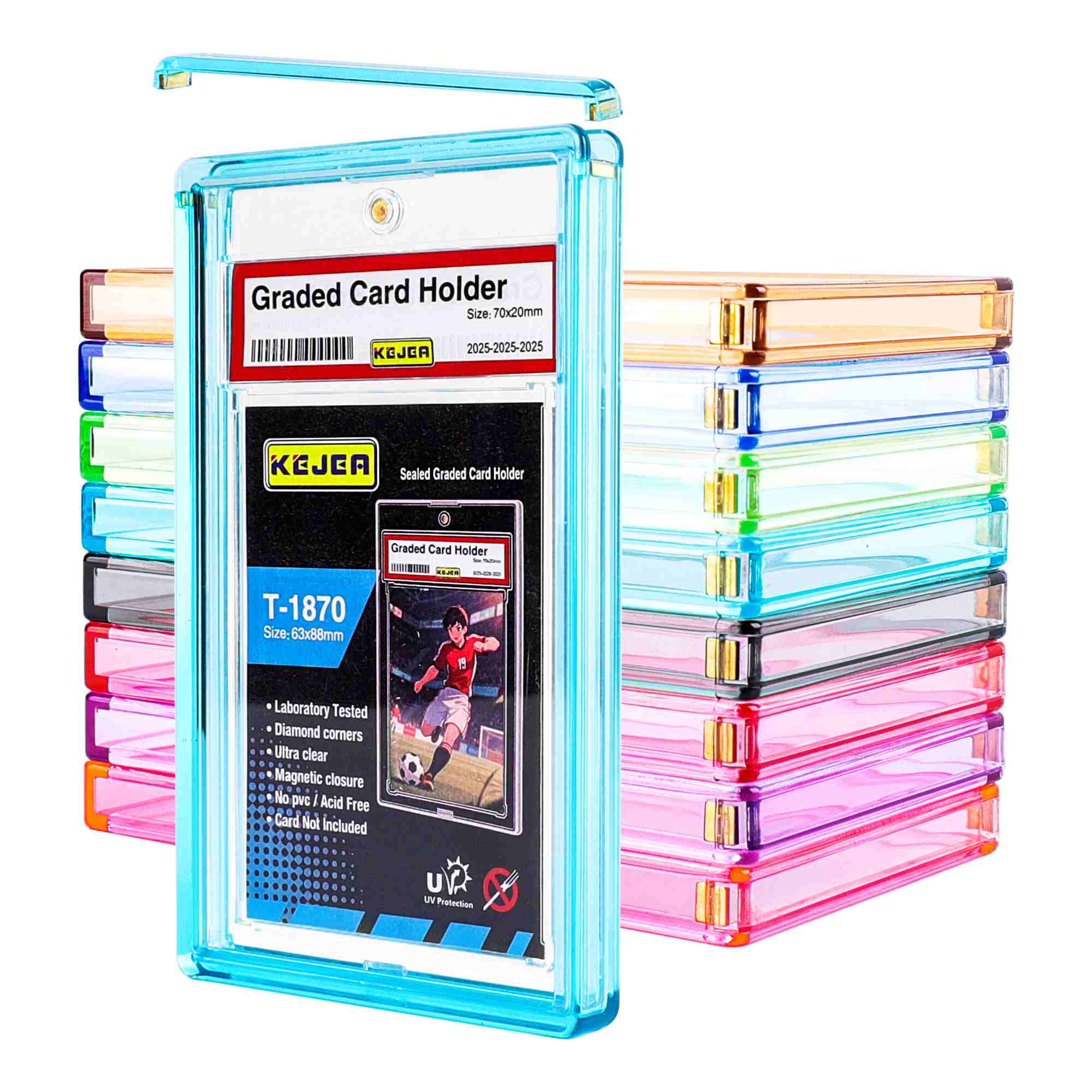
KEJEA’s official service structure covers OEM/ODM customization service, product design and sampling, custom mold development, custom packaging, and mass production quality control. Its product scope includes trading card sleeves, magnetic card holders, graded card protection, toploaders, Mini Snap products, and display accessories.
For a buyer, that breadth can simplify multi-SKU work, but it does not remove the need to define each SKU’s reference object, acceptance checks, and commercial assumptions separately.
The approved sample should remain tied to the quotation, packaging version, and production handoff so that later decisions can be checked against the same commercial reference.
Approve packaging after the product is stable
Packaging is part of the commercial product, but it should not be finalized ahead of the physical holder or sleeve. Confirm how units are separated, oriented, counted, labeled, and protected from visible marks.
Then use the servizio di imballaggio personalizzato discussion to request packed dimensions and gross weight so the buying team can review freight, storage, picking, and retail handling on the same basis as the product decision.
For private-label trading card accessories, provide authorized logo files, color references, barcode data, required language, and any market-specific importer or warning information.
Treat artwork as a controlled revision. If a product dimension, insert, count, or orientation changes, review the dieline and label placement again rather than assuming that the previous pack remains valid.
Build quality control around observable decisions

Define repeatable acceptance checks
Quality control should begin with the approved reference and the buyer’s acceptance method. Define what will be checked on incoming samples or production lots: dimensions that control fit, closure or insertion, visible surface condition, color or print version, unit count, labels, and carton configuration.
The goal is not to invent a laboratory claim. It is to make the agreed requirements repeatable for purchasing, warehouse, and supplier teams. Each checkpoint should describe an observable condition, such as whether the card enters without excessive force, whether the closure aligns, whether the approved artwork version is used, or whether the carton contains the stated pack quantity.
Link product changes to packaging changes
Keep product and packaging changes connected. A new tool revision may change the cavity or outer footprint. A different bag or insert may change the unit count or surface protection. A color or print change may affect the approved retail presentation.
Record the change, assess its buyer impact, and require a new approval where a critical decision has moved. This reduces avoidable disputes on repeat orders and gives the buyer a clear basis for deciding whether the revised sample can proceed to production.
Do not rely on broad claims such as “premium,” “scratch-proof,” or “perfect fit” without a defined condition and supporting evidence. If a market or customer program requires a particular document or test, name that requirement in the RFQ and confirm who supplies it. Material names alone do not establish legal compliance or performance for every application.
di KEJEA produzione di massa e controllo qualità service can be used as the production-stage destination after the physical and packaging references are approved. The buyer should still request the project-specific control points, sample identifiers, and change-notification method that apply to the chosen accessory. This keeps an OEM/ODM discussion grounded in a verifiable product and pack rather than in a general capacity statement.
Normalize the RFQ before comparing OEM proposals
A comparable RFQ makes each supplier respond to the same project. Include the reference object and dimensions, intended use, selected or proposed structure, material information requested, quantity assumptions, unit and carton packing, branding scope, destination market, and desired quotation basis. Ask the supplier to list exclusions, one-time development charges, artwork requirements, and open technical questions.
- Product brief: SKU, card or slab reference, sleeve condition, dimensions, use case, and channel
- Development path: existing model, modification, new mold discussion, or packaging-only customization
- Sample approval: test routine, revision number, acceptance conditions, photos or records, and decision date
- Packaging: selling unit, inner and master quantities, labels, barcode, artwork version, carton dimensions, and gross weight
- Commercial basis: quantity, currency, trade term, recurring unit cost, one-time charges, exclusions, and quotation validity
Conclusione
A trading card accessories OEM manufacturer should help buyers move from a clear product brief to a controlled, usable production reference. Define the protected object and channel, decide whether standard or custom development is justified, approve samples with observable checks, finalize packaging after the product is stable, and carry the approved revisions into mass production. That sequence protects both the buyer’s brand and the supplier relationship while keeping the RFQ commercially comparable.
Start a custom trading card accessories inquiry
If you are planning a private-label or multi-SKU TCG accessory program, start a custom accessory inquiry with the product brief, reference dimensions, estimated quantities, packaging concept, branding scope, and target market. KEJEA can then route the request to the relevant OEM/ODM, sampling, packaging, and production-control discussion.
FAQ
What should I send to a trading card accessories OEM manufacturer first?
Send a product brief before artwork: the card or slab reference, dimensions, sleeve condition, use case, sales channel, desired structure, quantity assumptions, and packaging concept. Add the acceptance checks you will use for samples. Logo files and color references are useful later, but they cannot replace a physical product definition.
When does a custom trading card accessory need a new mold?
A new mold may be relevant when the required cavity, closure, frame, or external geometry cannot be achieved through an existing model or a limited modification. Confirm the unmet requirement first. A color, logo, insert, or retail box may be a decoration or packaging change rather than a tooling project.
Quando è opportuno approvare gli imballaggi a marchio del distributore?
Approve packaging after the physical product, pack orientation, separation method, and quantity are stable. Then review the dieline, labels, barcode, language, and importer information as a controlled revision. Any later product or pack change should trigger a check of the artwork and carton plan.
How can buyers compare OEM quotations fairly?
Use the same product brief, sample conditions, selling unit, inner and master quantities, branding scope, destination assumptions, currency, trade term, and one-time-cost treatment for every supplier. Ask each bidder to list exclusions and unresolved questions. This prevents a standard item, a custom item, and a packaging-inclusive item from being compared as if they were identical offers.

Molecolare
Materie prime industriali versatili
Specifiche
Specifiche
Specifiche

Specifiche

Specifiche

Chiamaci
0769-88389789
Alte prestazioni
Guangdong KEPU Technology Co., Ltd.
Guangdong KEPU Technology Co., Ltd. è un produttore specializzato in soluzioni per la protezione delle carte collezionabili, che integra internamente ricerca e sviluppo, progettazione, produzione e controllo qualità. Grazie a una capacità produttiva scalabile, un sistema di controllo qualità consolidato e capacità OEM/ODM, forniamo un supporto di prodotto professionale e affidabile per il mercato globale del collezionismo e della rivendita di carte collezionabili.
- Siamo professionisti
- Utilizziamo materiali di qualità
- Soddisfazione del cliente al 100%